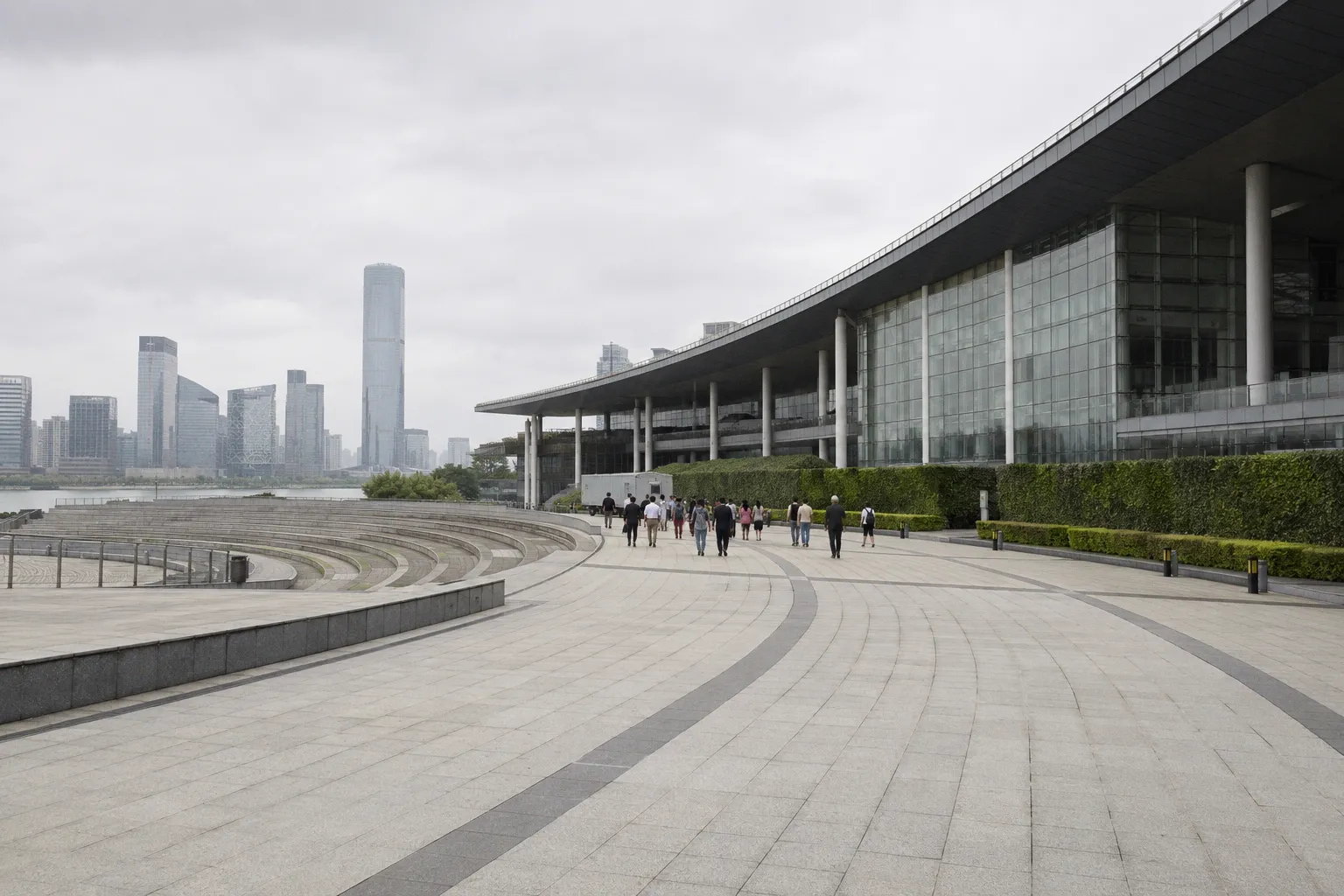
The Forum and Its Architecture
The session, titled "Filming in Australia: Incentives, Facilities and Co-Production Opportunities," was a calculated piece of soft power. AACTA Chair Jack Christian sat alongside Liu Kailuo, the producer-executive whose résumé spans Heyi Pictures, Youku, Wanda Pictures, and Galloping Horse; Geng Ling, founder of Soundfirm Beijing and a sound designer whose fingerprints can be traced from Zhang Yimou's *Hero* to the quiet menace of *Pali Road*; and the Australian producing duo Greer Simpkin and David Jowsey, the craftspeople behind *Sweet Country*, *Mystery Road*, and Warwick Thornton's forthcoming *Wolfram*. We watched a room full of financiers and studio executives absorb, through the panelists' exchanges, the full production pathway — federal and state incentives, studio infrastructure, post-production pipelines, co-production frameworks, locations that can stand in for almost any terrain the camera can imagine. It was, in essence, a pitch framed as a roundtable, and the structural intelligence of that choice told us everything about how seriously Australia is now taking its place in the regional conversation.
What It Signals for the Industry
Christian's framing was pointed and worth quoting at length: "Australia is an increasingly important partner for international producers looking for production value, reliable infrastructure and sophisticated screen partners." What we should register, though, is the subtext. With China's domestic market maturing and Western studios retrenching, the middle powers — Australia among them — are no longer content to be locations. They want to be co-authors. The week of Australian activity stretching from Shanghai into Chengdu and Guangzhou, anchored by the China Premiere of *Wolfram*, suggests a coordinated cultural strategy rather than a one-off market appearance. The upcoming UK-Australian co-production *Prima Facie*, also from Simpkin and Jowsey, hints at the template: bilateral projects that can travel through multiple territories without losing their authorial voice.
What to Watch
Three threads are worth following through the rest of the festival calendar. First, whether the Shanghai forum produces concrete co-production announcements before year's end — deals struck in rooms like this tend to surface at AFM or the European Film Market. Second, how *Wolfram* is received in its Chinese screenings; Thornton's work has always interrogated Indigenous sovereignty through a distinctly Australian lens, and its journey into Chinese exhibition spaces is, in itself, a small case study in cross-cultural circulation. And third, whether AACTA's Asia-Pacific engagement program extends beyond China into Korea, Japan, and India — the festival's calendar suggests the infrastructure is already there. For the screen culture we share, these are not bureaucratic footnotes. They are the quiet negotiations that determine which stories get made, and which voices get heard, in the decade ahead.