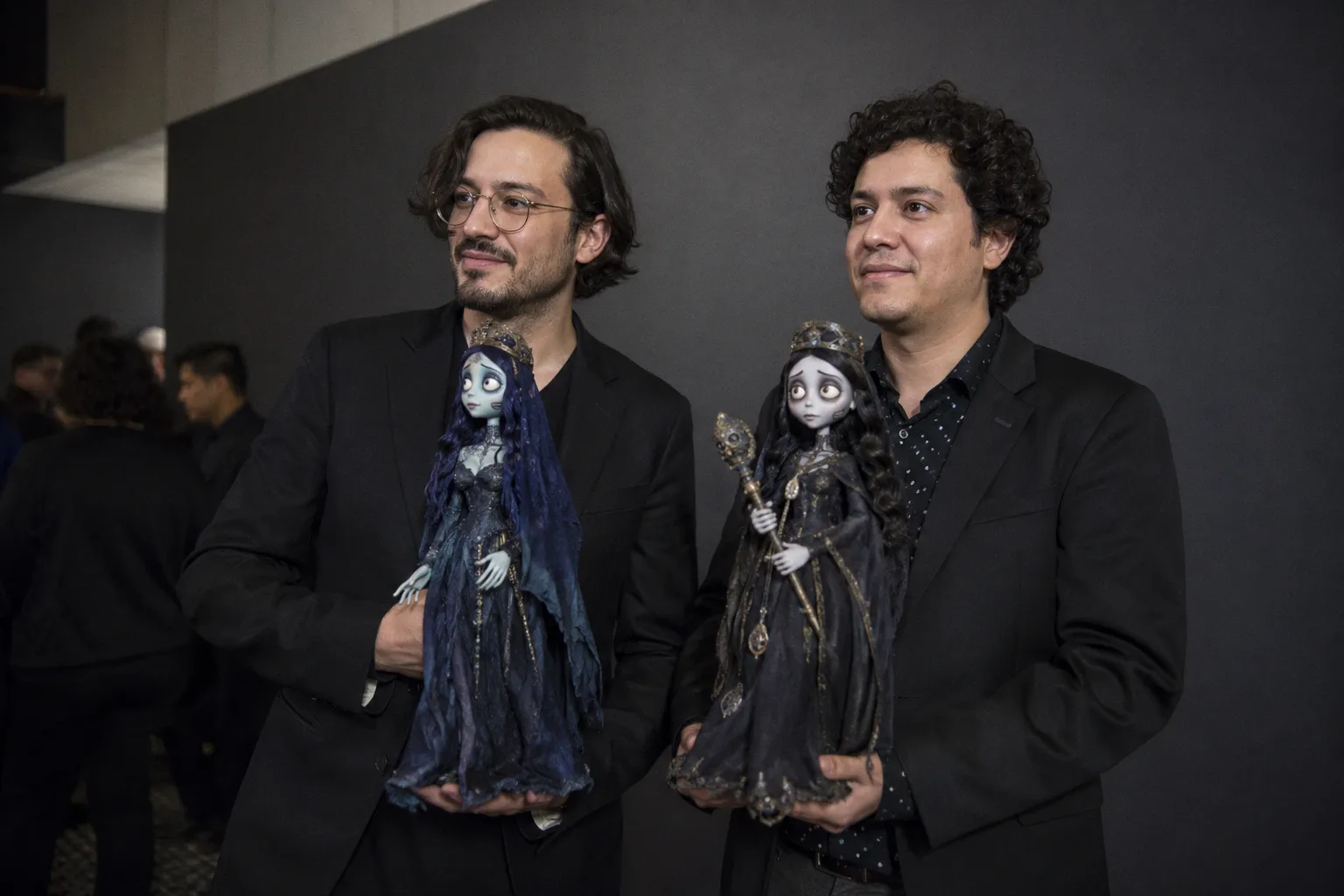
The Ambriz brothers, now directors operating out of their Mexico City-based studio Cinema Fantasma, received a VHS copy of Henry Selick's Burton-produced film during a childhood trip to the United States. They were three years old. The specifics of that origin story matter — the physicality of the tape, the inability to parse what they were seeing yet the compulsion to replay it endlessly — because they speak to how stop-motion lodges itself in memory differently than any other animation form. "We were obsessed with it," Roy Ambriz has said, and the obsession proved structural rather than merely sentimental.
From Nightmare to Realm of Terror
Where *Nightmare Before Christmas* built two distinct worlds — Halloween Town and Christmas Town — for Jack Skellington to navigate between, *I Am Frankelda* constructs a parallel architecture of realms. The film's title character, an eighteen-year-old author in the mold of Mary Shelley, travels from the Realm of Existence — situated in nineteenth-century Mexico — into the Realm of Terror, where her own literary creations manifest as living nightmares. The structural echo is unmistakable: a protagonist crossing thresholds between worlds, each governed by its own visual logic and emotional register.
Yet the Ambriz brothers have not simply replicated Burton's palette. Danny Elfman's songs and score gave *Nightmare* its musicality, and *I Am Frankelda* similarly weaves musical numbers throughout its narrative, but within a distinctly Mexican Gothic framework. We experience the film through cultural anxieties particular to its setting — the literary heritage of Romantic-era horror reimagined through a lens that Hollywood has largely overlooked.
The Physical, the Enduring
What Roy Ambriz admires most about Burton's 1993 film is precisely what the medium demands patience to achieve: its physicality. "It's without any CGI," he observed. "It's so beautiful … it feels so physical. It doesn't age, and that's what we wanted for *Frankelda*." This is not nostalgia masquerading as technique — it is a deliberate aesthetic commitment. Stop-motion's imperfections, the slight tremor in a handcrafted movement, the grain of materials catching light, generate an uncanny presence that digital replication consistently fails to approximate.
The Ambriz brothers' trajectory has been shaped by more than one towering figure. Guillermo del Toro has mentored them for seventeen years, and it was through the launch of *Tim Burton's Labyrinth*, Burton's exhibition in Mexico City, that the brothers finally met their childhood inspiration in person. Burton's reported response — "I'm excited about watching your film" — carries a particular weight when we consider the lineage at stake. One generation of fantastical filmmakers acknowledging the next.
Whether *I Am Frankelda* achieves the timeless quality its directors aspire to remains something we will assess over years rather than opening weekends. But the film's arrival as what IndieWire describes as Mexico's first stop-motion feature already positions it as a landmark — a work that translates a very specific childhood enchantment into something culturally expansive, proving that the best artistic inheritance does not mimic its source but metabolizes it into something with its own stubborn, handcrafted life.