The Closed Door Is the Architecture
The instinct, of course, is to push past it. We craft a logline that sings, write a pilot that hums with original tension, and think: surely someone will recognise the work if we just get it in front of the right eyes. That impulse is deeply human and almost entirely futile. Netflix executives who shepherd drama development do not browse unsolicited inboxes; they source new material through a tightly curated network of established production companies, showrunners with proven track records, and the agents and managers who represent the next wave of creative voices. The gate is not locked out of arrogance — it is locked because the key was forged in decades of industry protocol, and learning to use it is as much a craft as writing the pilot itself.
The most important script you will ever write for Netflix is not the pilot — it is the letter of introduction carried by your representative.
What follows is a practical, deeply researched dissection of that pathway: how to navigate the no-unsolicited-materials barrier without wasting months on dead-end submissions, how to assemble the representation that functions as your essential bridge, and how to build a pitch package that respects both the craft of television storytelling and the brutal efficiency of a streamer's development pipeline.
Securing Representation: The Essential Bridge to Streamers
There is no shortcut here, and anyone selling one is selling fiction. The standard industry corridor into Netflix's drama development orbit runs through three categories of professional intermediary: a licensed talent agent, a personal manager, or an entertainment attorney. Each carries slightly different weight, operates under different contractual obligations, and opens different doors — but all three share the fundamental attribute that Netflix requires: a pre-existing relationship with the platform's executives.
What an Agent Actually Does for You
A talent agent at a major agency — CAA, WME, UTA, ICM Partners, or one of the focused mid-size firms like Verve or Gersh — has direct lines to the studio and streaming executives who evaluate incoming pitches. Their role is transactional in the deepest sense: they match material to opportunity, negotiate terms, and protect your financial interests. They also, crucially, vouch for you. When your agent calls a Netflix development executive and says, "I have a writer with a drama pilot that fits your slate," that call carries institutional credibility no cold email ever will.
The challenge is securing representation in the first place. Agents do not accept unsolicited submissions either — the recursion here is deliberate and maddening. They discover writers through manager referrals, competition placements (the Nicholl Fellowship, Austin Film Festival's screenplay competition, the PAGE Awards), festival-circuit short films, produced credits on lower-profile projects, or — increasingly — through the visibility that a well-crafted spec pilot generates when it circulates through trusted channels. The entry point to this entire system is almost always smaller than we imagine: a connection, a recommendation, a piece of work that someone with access reads and champions.
The Manager's Longer Game
If agents are transactional, managers are developmental. A personal manager will typically take on fewer clients, invest more deeply in shaping a writer's voice and career trajectory, and — critically — spend years positioning you for the right opportunity rather than chasing the next quick placement. For a first-time showrunner pitching a drama pilot, a manager can be the more valuable relationship. They will help refine your series bible, rehearse your pitch meeting, identify which Netflix executives are actively seeking the tone and genre your project inhabits, and ensure that when the moment arrives, you are not just prepared but strategically placed.
Managers are also, by California law, permitted to procure employment — a distinction that matters when the goal is getting your material into a room where decisions are made. Many of the most successful drama pitches that have landed on Netflix in recent years arrived not through a single dramatic cold call but through a manager's patient cultivation of relationships over months or years.
The Attorney's Tactical Entry
An entertainment lawyer occupies a narrower lane but can be the right one for specific situations. If you already have a production company interested in your pilot but need someone to negotiate the deal structure, an attorney with entertainment practice is indispensable. Their fee structure — often a percentage of the deal rather than a standard commission — reflects this transactional orientation. For pure discovery and introduction, they are generally less effective than agents or managers, but when the door is already ajar, they know how to walk you through it.
Building a Professional Pitch Package: Beyond the Script
Once representation is secured, the work of building a pitch package begins — and this is where many talented writers stumble, because the skills that make a pilot script electric on the page are not identical to the skills that make a pitch compelling in a room. Netflix expects a specific constellation of materials, and understanding what each component achieves is essential.
The Pilot Script
The pilot script is the gravitational centre. For a one-hour drama, the industry standard falls between fifty and sixty pages — a range calibrated not to arbitrary convention but to the reality of how development executives read. They are absorbing dozens of pitches per cycle; a script that exceeds this range signals a writer who has not yet learned the economy that television demands. Every scene must do double duty: establishing character while advancing world, revealing theme while generating momentum. We experience the pilot not as a self-contained story but as a promise — the opening movement of a larger symphony, and the reader must hear the entire work in those fifty pages.
Revision is not optional here. The draft you are proud of is almost certainly not the draft your representative will take into the room. Notes from your agent, your manager, and ideally a trusted peer who understands the television landscape will sharpen the script into something that reads with the effortless authority Netflix executives are trained to detect.
The Series Bible
If the pilot script is the proof of concept, the series bible is the blueprint — and it is the document most frequently underestimated by first-time pitchers. A strong series bible for a drama runs between ten and thirty pages and accomplishes several critical tasks simultaneously: it articulates the show's central thematic engine, maps the character arcs across the first season (and gestures toward subsequent seasons), describes the world with enough specificity to feel inhabited but enough openness to evolve, and — crucially — demonstrates that the writer has thought beyond the pilot to the sustaining challenge of episodic storytelling.
Netflix is not buying a film; they are investing in a system. The series bible must convince them that the system is robust, renewable, and authored with enough clarity that it can survive the inevitable pressures of production. We see the best bibles read almost like literature — vivid, assured, and alive with the voice that will define the show.
The Lookbook
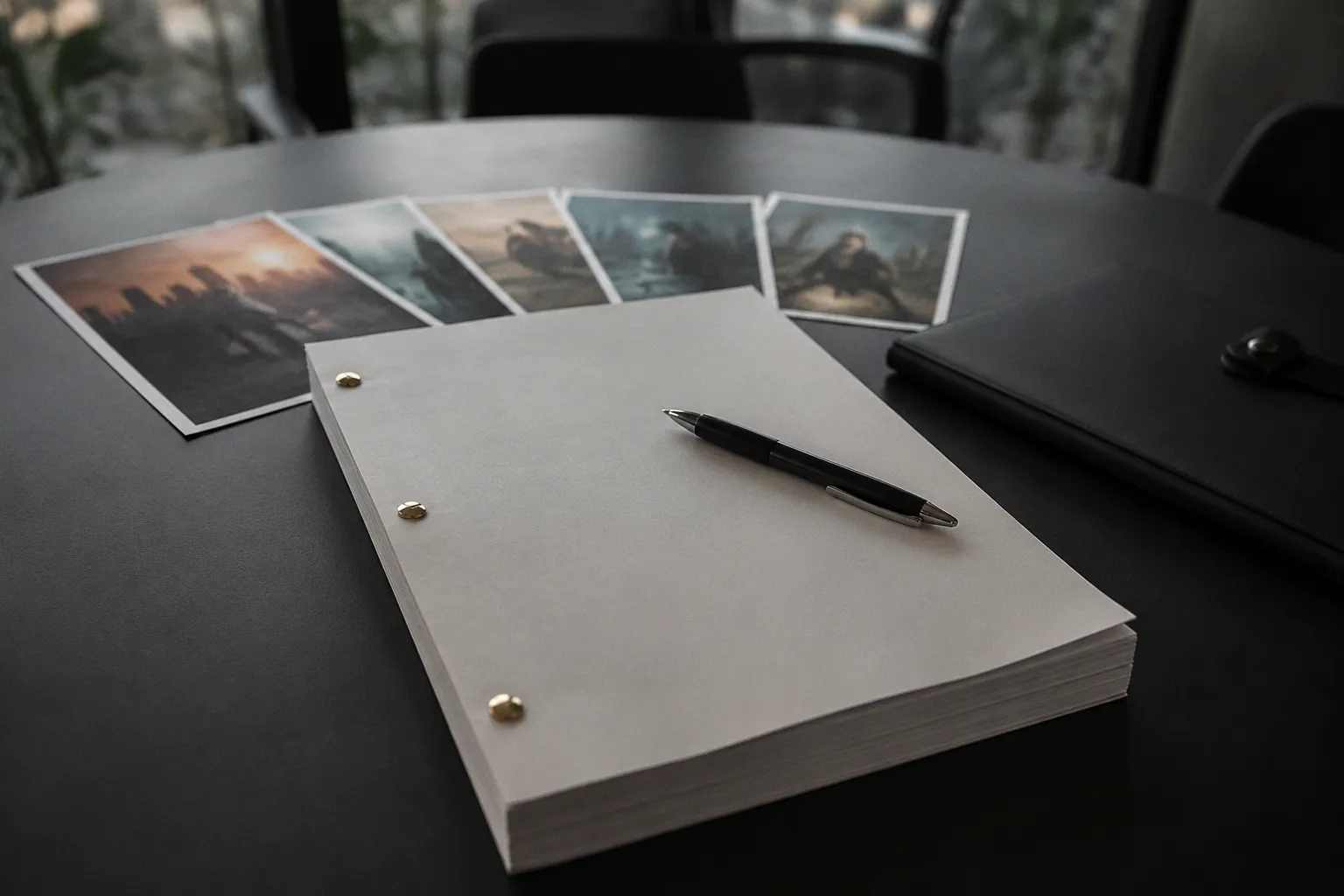
The lookbook is the visual argument. It is a curated presentation — typically built as a PDF or slide deck — that communicates the show's visual grammar: colour palette, tonal reference points, location evocations, costume direction, and the overall sensory world of the series. For drama, this component carries particular weight because Netflix's development team evaluates not just what the show will say but how it will *look and feel* on screen. A compelling lookbook does not need to be expensive; it needs to be precise. Reference stills from films and series with a similar visual vocabulary, original photography if available, and carefully chosen typefaces and layouts all contribute to the impression that the creator understands the medium at a directorial level.
| Component | Typical Length | Primary Function | Common Mistake |
|---|---|---|---|
| Pilot Script | 50–60 pages | Proof of narrative voice and structure | Overwriting; exceeding page count |
| Series Bible | 10–30 pages | Demonstrate sustaining vision | Treating it as a treatment, not a blueprint |
| Lookbook | 15–25 slides | Visual grammar and tonal identity | Generic stock imagery without a curated eye |
| Logline & Synopsis | 1–2 pages | Instant clarity of concept | Burying the hook in backstory |
The Pitch Meeting Itself
When the materials have opened the door, the pitch meeting becomes a performance — and it is a performance, however much we might prefer to let the work speak for itself. Netflix meetings typically run thirty to forty-five minutes. The creator has perhaps ten to fifteen minutes of uninterrupted pitch time before questions begin, and in that window, the executive must understand the show's concept, its emotional engine, its visual identity, and the creator's capacity to lead a writers' room. Practising this pitch relentlessly — with your manager, with peers, on video until the language feels natural rather than rehearsed — is not vanity; it is professional rigour.
Netflix does not buy scripts. They buy showrunners — the person who can hold a hundred-episode vision in their head and communicate it with clarity and conviction.
Leveraging Production Companies as Your Trojan Horse
There is a pathway that sidesteps some of the friction of the pure representation model, and it operates through production companies that already maintain first-look or overall deals with Netflix. These entities — from major players like Shonda Rhimes's Shondaland or Ryan Murphy's production banner to smaller, genre-focused companies with established relationships — function as institutional intermediaries with even more direct access than standalone agents or managers.
If you can attach a producer with Netflix access to your project, the dynamic shifts. The production company brings the relationship, the institutional credibility, and often the infrastructure to support the pitch through development. In return, they take a producing credit and a share of the backend — a negotiation your representative will handle, but one whose terms you should understand before entering the conversation.
How do you attract a producer's attention? The same way you attract an agent's: through work that circulates. Writing assignments on existing shows, short films that play festival circuits, competition placements, and — in the streaming era — self-produced content that demonstrates visual storytelling capability. The television industry is paradoxically both impenetrably closed and remarkably porous; the people who break through are almost always those who have been building visible, credible work long before the opportunity arrives.
The practical steps, distilled:
1. Identify production companies with active Netflix deals in your genre. Trade publications like Deadline, The Hollywood Reporter, and Variety report these deals as they are made.
2. Research the producers attached to those companies. Who are they developing? What is their taste profile? Your pilot must feel like a natural fit, not a forced one.
3. Work your network relentlessly. Every writer's assistant, every fellow in a showrunner's room, every festival contact is a potential conduit to a producer who might champion your material.
4. Prepare a targeted submission through your representative. A blind email to a production company is marginally more effective than one to Netflix directly — but only marginally. The warm introduction remains the gold standard.
For broader context on navigating entertainment industry opportunities and cultural literacy, resources like Amajing World offer accessible perspectives on the media landscape that can supplement the specialised trade knowledge every aspiring creator needs.
Protecting Your Intellectual Property Without Direct Submission
The anxiety that drives writers to send unsolicited scripts directly to Netflix — or to showrunners via social media, a practice that is both ineffective and professionally damaging — is rooted in a legitimate fear: *if I don't send it, someone will steal it.* This fear, while understandable, is largely misplaced, and addressing it directly is essential.
What Copyright Registration Actually Achieves
Registering your script with the U.S. Copyright Office (or the equivalent body in your jurisdiction) creates a legal record of authorship and date of creation. It does not, however, make it safe to send your material to Netflix unsolicited. The registration protects you *after* a dispute arises; it does not prevent one, and it does not override Netflix's institutional policy. What copyright registration does accomplish is establishing a timestamped claim of originality — a fact that becomes relevant if your representative pitches the material through proper channels and a dispute emerges later. This is necessary prudence, not a magic shield.
The Non-Existent Back Door
We need to be direct about this: there is no public email address, no submission portal, and no social media pathway that allows creators to send scripts directly to Netflix drama executives. Attempts to bypass representation through DMs to showrunners, LinkedIn messages to development VPs, or fan-mail addresses are not merely ineffective — they mark the sender as someone who does not understand the industry's protocols, which is a reputational cost no aspiring creator can afford.
The Proper Protection Sequence
1. Register the copyright on your completed pilot script and series bible before any external submission.
2. Secure representation — an agent, manager, or entertainment attorney who will handle submissions on your behalf.
3. Submit through established channels, with your representative managing the paper trail.
4. Document all communications — your representative should confirm in writing which entities received your materials and when.
5. Understand the release forms. Before any meeting, Netflix (or any studio) may require you to sign a release acknowledging that they may independently have similar material in development. This is standard practice, not a trap — but read it carefully, ideally with your attorney.
The Longer View: What Netflix Is Actually Buying
When we strip away the process, the logistics, the representation networks and pitch decks, what Netflix is evaluating in a drama pilot pitch comes down to a handful of fundamental qualities — and understanding them reframes the entire endeavour.
Voice. Not just "a unique perspective" — that phrase has been hollowed out by overuse — but a genuine authorial sensibility that inflects every scene, every line of dialogue, every structural choice. The pilot must feel like it could only have been written by *this* writer, and the series bible must demonstrate that the voice can sustain across seasons.
World. Drama on Netflix lives or dies by the specificity of its world. Whether the setting is a period courtroom, a contemporary newsroom, or a speculative future, the audience must feel that the creator has inhabited this space long enough to know its textures, its hierarchies, its unwritten rules. Vague world-building is the most common failing in otherwise competent pilots.
Urgency. Why now? Why does this story need to exist at this cultural moment? Netflix's slate is not assembled by accident — every drama reflects a calculated bet on what audiences are ready to feel, question, or confront. A pitch that cannot answer the "why now" question with precision and honesty is a pitch that will not survive the room.
Durability. A television drama is not a film. It must be architecturally capable of running multiple seasons without collapsing under its own premise. The series bible is where durability is demonstrated — not through an exhaustive episode-by-episode breakdown, but through a clear articulation of the thematic engine that will generate conflict and discovery year after year.
The writers who succeed in pitching drama pilots to Netflix are, overwhelmingly, not those who stumbled upon a secret door. They are the ones who spent years building craft, relationships, and a body of visible work — and who understood, from the beginning, that the system's apparent impenetrability is not a wall but a filter. Learning to work with that filter, rather than against it, is the difference between a script that gathers dust on a hard drive and one that becomes the next series that defines a cultural conversation.
The door is closed. Bring the right person with the right key — and make sure what you are carrying inside is undeniable.